
14 Apr How Magnesium Oxide Panels Stack Up Against Other Exterior Wall Materials
When you choose magnesium oxide panels for exterior walls, you gain numerous advantages. These panels offer exceptional fire resistance, excellent moisture protection, and impressive longevity. You can observe how magnesium oxide panels for exterior walls perform well in harsh outdoor conditions. The table below compares the benefits of magnesium oxide panels, magpanel, and other materials:
Material | Durability | Water Resistance | Fire Resistance |
|---|---|---|---|
OSB Sheathing | Moderate | Poor | Moderate |
Fiber Cement Board | Highly Durable | Excellent | Excellent |
Magnesium Oxide Panels | Highly Durable | Excellent | Excellent |
As you can see, magnesium oxide panels for exterior walls and magpanel provide superior benefits compared to OSB. Additionally, magnesium oxide panels are more environmentally friendly. You receive safety and long-lasting value with each panel, making magnesium oxide panels for exterior walls an excellent choice.
Key Takeaways
Magnesium oxide panels are very good at stopping fires. This makes them safer for buildings where fires can happen.
These panels keep out water very well. They help stop mold and water damage, especially in wet places.
MgO panels do not weigh much and are simple to put up. This saves time and money when building.
Picking magnesium oxide panels can help you save money for a long time. They last a long time and do not need much care.
Use chloride-free MgO boards near the ocean to stop rust. This helps them last longer.
Fire Resistance of Magnesium Oxide Panels
MgO Boards vs. OSB
You want your building to be safe from fire. MgO boards make walls that do not burn easily. They last a long time. OSB panels do not keep you as safe. MgO boards do not catch fire and can handle high heat. OSB panels can catch fire fast and burn quickly. You can see how they compare in the table:
Material | Fire Rating |
|---|---|
MgO Board | Highly fire-resistant, noncombustible, 1-2 hours fire resistance |
OSB Panel | Not fire-resistant, ignites easily under high temperatures |
MgO boards work better in places where fires can happen. You can trust MgO boards to keep your building safe.
MgO Boards vs. Gypsum
Gypsum boards slow down fire, but you need more layers or special coatings for better safety. MgO boards give you 1-2 hours of fire protection without extra steps. MgO boards are called noncombustible. Gypsum boards do not reach this level. Look at the table to compare them:
Material | Fire Resistance Rating | Notes on Fire Resistance |
|---|---|---|
Magnesium Oxide (MgO) Board | Up to 1-2 hours; rated noncombustible (ASTM E136 & E84) | Highly fire-resistant, superior to gypsum and fiber cement boards |
Gypsum Board | Fire-resistant but requires multiple layers or treatments | Less fire resistance unless enhanced |
MgO boards give you better fire safety and help you worry less.
MgO Boards vs. Fiber Cement
You might wonder how MgO boards compare to fiber cement boards. MgO boards are better at stopping fire. Fiber cement boards can resist fire, but MgO boards do even better in tests. MgO boards are lighter and easier to put up. Fiber cement boards are heavy and take more work to install. Here is a table to show the differences:
Feature | Magnesium Oxide Boards (MgO) | Fiber Cement Boards |
|---|---|---|
Fire Resistance | Superior fire resistance; ideal for fire-prone areas | Good fire resistance; suitable for fire protection |
Durability | Excellent longevity, even in high humidity | Reliable in harsh weather |
Water Resistance | Fully waterproof | Moisture-resistant |
Weight & Installation | Lightweight; easy to install | Heavier; more labor needed |
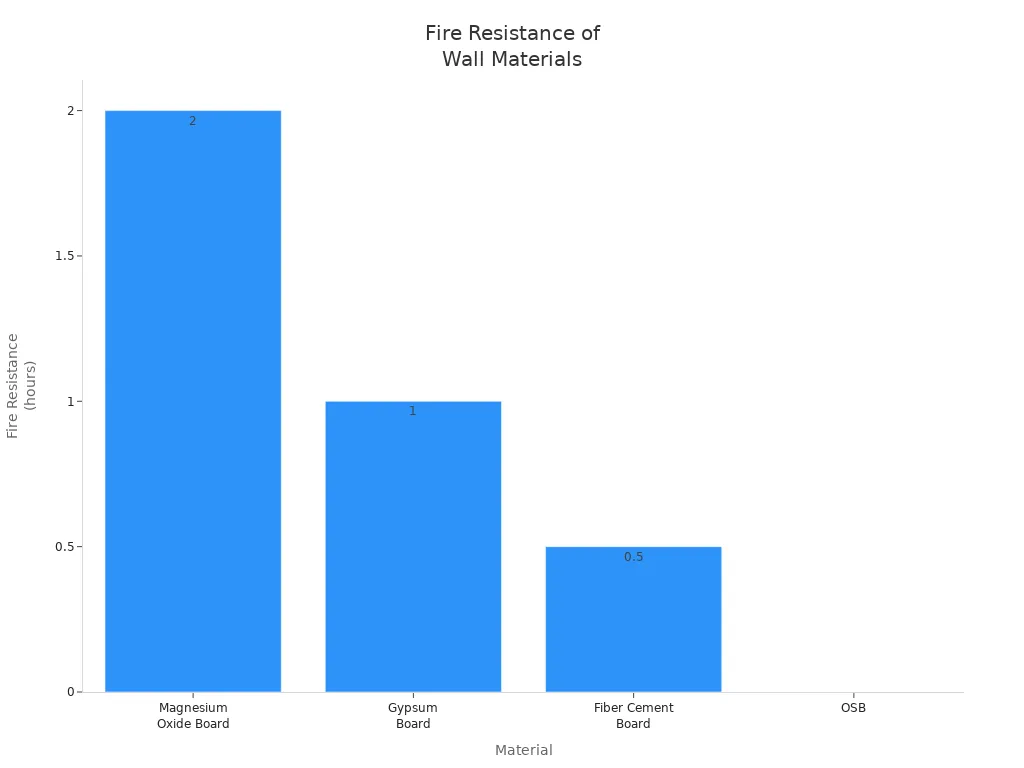
MgO boards make walls that do not burn. You can count on MgO boards to keep you safe in places where fires can happen. When you look at MgO and fiber cement boards, MgO is better for fire safety and is easier to use.
Tip: Pick MgO boards for outside walls if you want the best fire protection and strong walls.
Durability and Longevity
Magpanel MGO vs. Cement Board
You want your building to last a long time. Magpanel mgo and cement board are different in many ways. Magpanel mgo is very fire-resistant and fully waterproof. Cement board can handle water, but you must seal it for best results. Magpanel mgo stays strong in humid places and does not lose strength. The table below shows how these materials compare:
Material | Fire Resistance | Moisture Resistance | Durability & Strength |
|---|---|---|---|
MGO Board | Fully waterproof | Excellent in humid conditions | |
Cement Board | Good | Moisture-resistant | Reliable, needs sealing |
Magpanel gives you great durability and lasts a long time. Cement board also lasts, but magpanel mgo is better in tough places. You can trust magpanel to keep your walls strong for many years.
Tip: Pick magpanel mgo if you want walls that stay safe and strong, even when the weather is wet or changes a lot.
MgO Boards in Humid and Coastal Environments
If you live where it rains a lot or near the sea, your walls need to be tough. These places can hurt many wall materials. Fiber cement boards do well with rain, humidity, frost, and wet-dry cycles. Mgo boards also work well, but you must pick the right type. Some mgo boards made with chloride can have problems like salt coming out and metal rusting in very wet or coastal areas.
You can stop these problems by using chloride-free mgo boards, like those made with magnesium sulfate (MgSO₄). These boards do not make metal fasteners rust. They stay strong in high humidity. Mgo boards are better than drywall, plywood, and OSB in wet places. You can use them in flood zones or near the coast for better results.
Fiber cement boards last a long time in bad weather.
Mgo boards with the right formula do not break down in wet places.
Drywall, plywood, and OSB do not last as long in wet areas.
You get strong walls and a long life when you choose the right mgo board for your weather.
Fastener Withdrawal and Impact Resistance
You want your walls to be strong, even if they get hit or used a lot. Mgo panels are very strong. They hold screws and nails tight, so they do not pull out. Mgo panels do not dent or crack as easily as gypsum or cement boards. The table below shows how mgo panels compare to other materials:
Performance Metric | Innovation MgO Panels | Competing Materials (Portland Cement, Gypsum) |
|---|---|---|
Fastener Withdrawal Resistance | Superior | Inferior |
Impact Resistance | Greater | Lower |
Flexural Strength | Higher | Lower |
Compressive Strength | Exceeds | Lower |
Tensile Strength | Exceeds | Lower |
Shear Resistance | High | Lower |
Water Resistance | Greater | Lower |
Change in Flexural Strength (25 cycles of wetting-drying) | Negligible change | OSB (40%), Plywood (9%), Gypsum (36-52%) |
Mgo panels keep their shape and strength after many wet and dry cycles. This means your building stays safe and strong for a long time.
Note: Mgo panels are a good choice for busy places, schools, or buildings with lots of people moving around.
How Long Do These Materials Last?
You may wonder how long your walls will last. Mgo panels last about 33 years on average. Fiber cement boards can last over 50 years, and sometimes up to 100 years if you take care of them. Both materials last a long time, but fiber cement boards may last longer with good care.
Material | Average Lifespan |
|---|---|
Magnesium Oxide Panels | Approximately 33 years |
Fiber Cement Boards | Over 50 years (up to 100 years with care) |
Mgo panels give you many years of use. You get strong and long-lasting walls, especially if you pick the right type for your weather.
Remember: Always check what kind of mgo board you use. Chloride-free boards work best in wet or coastal places.
Moisture and Mold Resistance
 MgO Boards vs. Fiber Cement
 MgO Boards vs. Fiber Cement
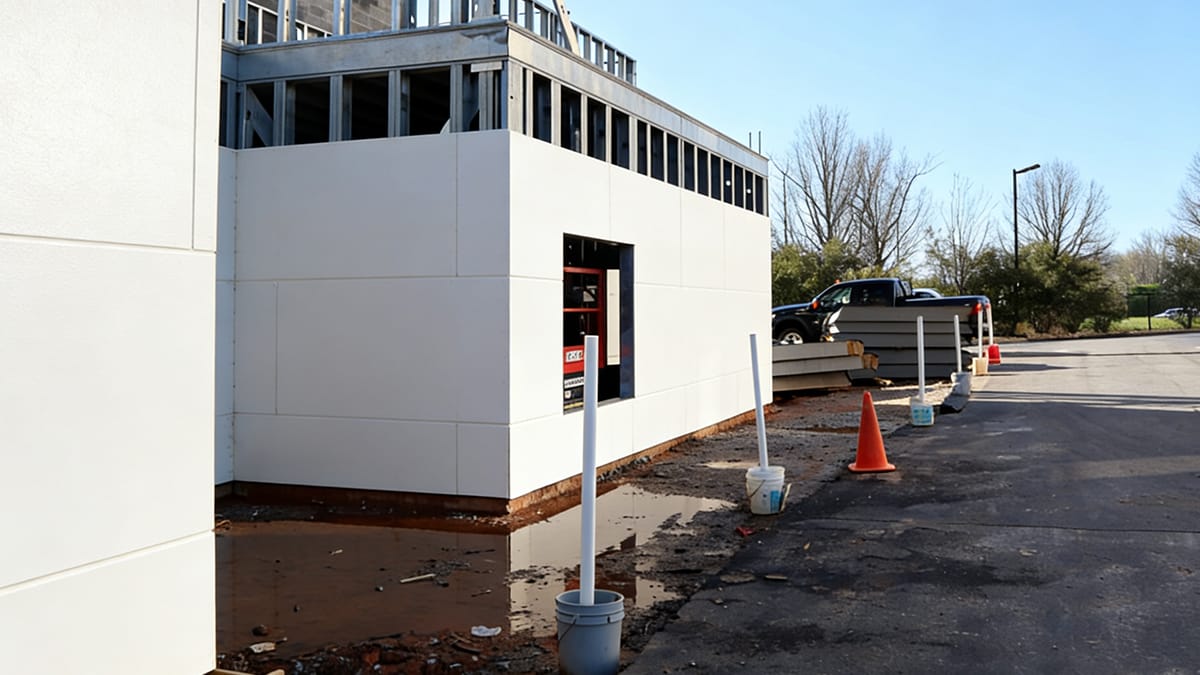
You want your exterior walls to stay dry and strong. MgO boards give you excellent moisture resistance. Fiber cement boards also resist water, but MgO boards absorb much less moisture. This means your walls stay safe even in wet weather. You can see the difference in the table below:
Material | Moisture Absorption | Mold Susceptibility |
|---|---|---|
MgO Board | Very low (approx. 0.34%) | Low |
Fiber Cement | Low | Low |
MgO boards keep their shape and strength when exposed to water. Fiber cement boards do well, but MgO boards offer even better moisture resistance. You get more protection for your building.
Water Absorption and Mold Prevention
You need walls that do not let water in. MgO panels absorb less than 10% water. They keep their strength in wet places. Plywood and drywall absorb more water and can grow mold. MgO panels prevent mold and mildew, making them a smart choice for humid areas.
Property / Material | Magnesium Oxide (MgO) Board | Plywood | Drywall (Gypsum Panels) |
|---|---|---|---|
Moisture Absorption | Less than 10% | Higher | Higher |
MgO panels work well in high-humidity areas.
They do not absorb much water.
You do not have to worry about mold or mildew.
Laboratory tests show that MgO boards resist mold growth. When tested for 28 days with fungi, MgO boards showed no fungal growth. You can trust MgO panels to keep your walls clean and safe.
Pest and Chemical Resistance
You want your walls to last and stay healthy. MgO panels stop water and mold damage. They keep their strength and shape, even in humid conditions. Unlike gypsum board, MgO panels do not break down when wet. MagPanel boards also resist insects, fungus, and chemicals. You get more durability and less worry about pests or harsh chemicals.
MgO panels resist insects and fungus.
They are non-toxic and safe for your family.
MagPanel boards last longer than many traditional materials.
Tip: Choose MgO panels if you want excellent moisture resistance, mold prevention, and strong protection against pests and chemicals.
Environmental Impact
Health and Sustainability of MgO Boards
You want your family and the earth to be healthy. Using mgo boards helps the planet. These panels do not let out bad chemicals into the air. You can use them in homes, schools, and hospitals. Mgo boards help make indoor spaces safe. They also help with green building goals. Many projects use mgo boards to get LEED certification. This means you help the earth and build better at the same time. Magpanel is a smart pick for eco-friendly and green building.
Mgo boards are known as a green choice for building.
You can check for certifications like CE, ASTM, SGS, and LEED.
For fire safety, look for ASTM E84 certification.
Mgo boards can help you get points for LEED.
Manufacturing and Recyclability
You want to know how building materials affect the earth. Mgo panels use less energy to make. They create less carbon pollution than cement boards. You help cut down on pollution when you choose mgo panels. Magpanel is special because you can recycle it all. You can reuse big pieces or grind them for new uses. You can even use crushed boards to help soil. This helps the planet and makes less waste.
Material | Recyclability | End-of-life Disposal Options |
|---|---|---|
MgO Boards | Small panels, filler, cement, soil enrichment | |
OSB | Recyclable | Fewer environmental benefits |
Feature | Magnesium Oxide Panels | Traditional Materials (e.g., Cement Boards) |
|---|---|---|
Carbon Emissions | 22% less than cement | High emissions |
Manufacturing Process | Less energy, lower temperature | More energy, high temperature |
Recyclability | 100% recyclable | Often end up in landfills |
Environmental Impact | Inert, landfill friendly | Can pollute soil and water |
Certifications and Green Building
You want your building to be good for the earth. Mgo boards help you reach these goals. They use closed-loop manufacturing and make very little waste. You can make indoor air better and save energy with mgo panels. Magpanel helps you build for the future.
MgO Panels | Traditional Materials | |
|---|---|---|
Closed-loop manufacturing | Yes | No |
Minimal waste generation | Yes | Varies |
Recyclability | Yes | Limited |
Indoor air quality | Yes | Often compromised |
Reusability | Yes | Limited |
Energy performance improvement | Yes | Varies |
Tip: Pick mgo panels if you want to help the earth, make less waste, and have a healthy building.
Installation and Handling
Weight and Workability of MgO Boards
 Weight and Workability of MgO Boards
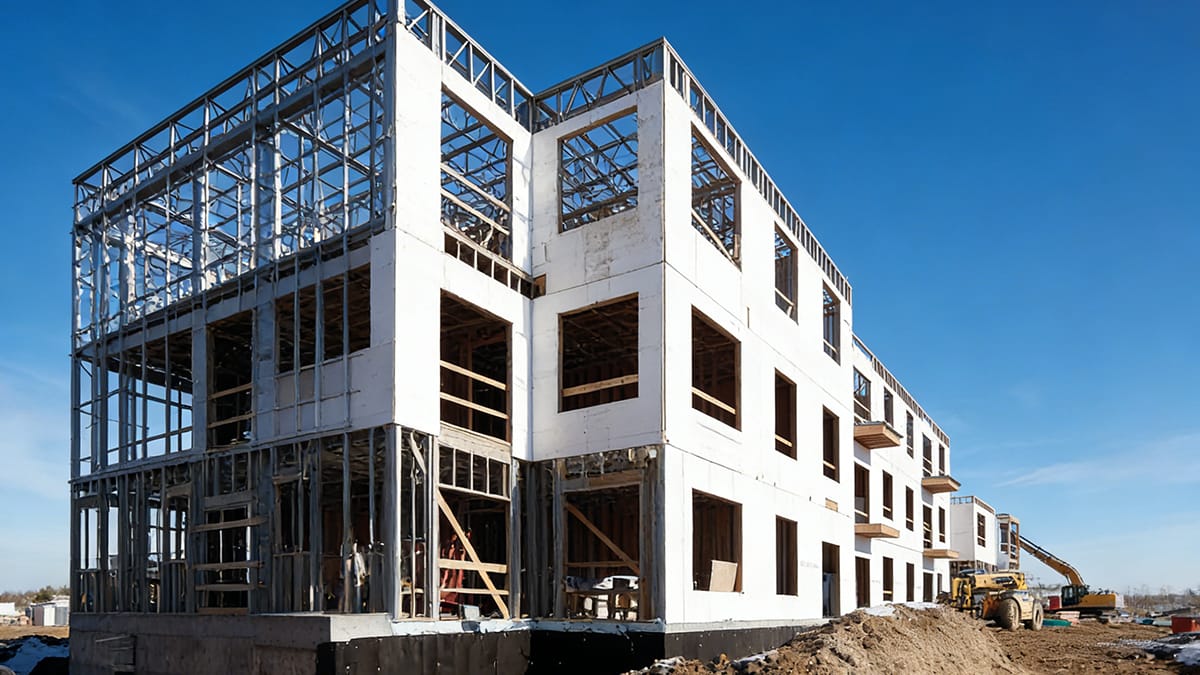
You will notice that mgo boards are lighter than cement boards. This makes them easier for you to carry and move on the job site. You can lift and position these panels with less effort. You do not need special equipment for most projects. You can cut mgo boards quickly with standard tools. They do not chip or crack easily, so you get a smooth edge every time. You will also see less dust when you cut them, which keeps your work area cleaner.
Mgo boards are lighter than cement boards.
You can cut them with regular tools.
They do not break or chip easily.
Less dust means a cleaner workspace.
This ease of installation helps you finish your project faster and with less mess.
Cutting, Fastening, and Safety
You can cut mgo panels outdoors or use a vacuum to keep dust away. Always wear safety glasses, gloves, and a dust mask when you work. You should follow local building codes for every project. Mgo boards support green building because they create less pollution and can be recycled. This makes your job site safer and better for the environment.
Here are some best practices for installing mgo panels:
Installation Aspect | Best Practice / Quantitative Tip |
|---|---|
Acclimation Time | 48 hours in installation environment |
Screw Spacing | 16″ centers recommended |
Edge Gap (Expansion) | 1/8 inch around perimeter walls |
Board Placement Gap | 1/16 inch between boards on steel framing |
Fastener Material | 316 stainless steel or ceramic coated fasteners |
Tip: Always use the right fasteners and allow for small gaps to help your walls last longer.
Labor and Time Efficiency
You will find that mgo panels and magpanel can save you time during installation. You need fewer workers because the panels are lighter and easier to handle. Skilled installers can work quickly with these boards. Gypsum board is easier for beginners, but mgo panels give you strong and lasting walls. Magpanel also helps you finish jobs faster because you do not need to seal or treat the panels as much as other materials.
Factor | Magnesium Wall Board | Gypsum Board |
|---|---|---|
May be higher | Lower | |
Labor Requirements | Fewer, skilled | DIY-friendly, less skill needed |
You get reliable results and a smooth finish with mgo panels. The ease of installation makes them a smart choice for many building projects.
Cost and Value
Material and Installation Costs
You want to know how much you will spend on exterior wall materials. The price of each panel matters for your budget. You can see the cost of different wall boards in the table below:
Material Type | Cost per Sheet (4×8 ft) |
|---|---|
$25 – $40 | |
Standard Drywall | $10 – $15 |
Moisture-Resistant Drywall | $15 – $20 |
Plywood | $10 – $20 |
Oriented Strand Board (OSB) | $10 – $20 |
Fiber Cement Board | > $40 |
Structural Insulated Panels | > $40 |
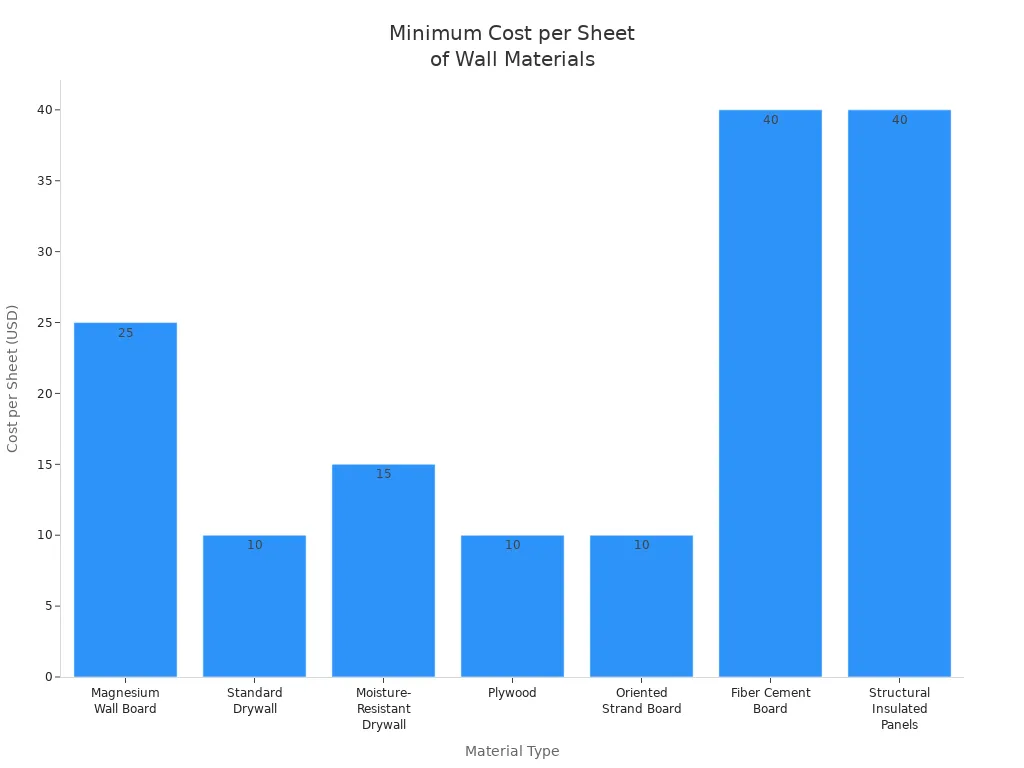
You may notice that mgo panels like magpanel cost more than OSB or drywall. Fiber cement and structural insulated panels cost even more. You pay a bit more for mgo, but you get better performance. Magpanel gives you a longer lifespan for your building. You also save money because you need less product in many cases. You can finish your project faster since installation time is shorter. This means you spend less on labor. You also do not need extra backing for light shelves because mgo is strong.
Tip: When you look at the total cost, remember to include labor and how much material you need. This helps you see the real roi for your project.
Maintenance and Long-Term Value
You want your walls to last and not cost you more later. Mgo panels give you strong fire and moisture resistance. You do not need to add extra coatings or layers to meet building codes. This saves you money and time. Over the years, you will spend less on repairs and replacements. Mgo does not rot, swell, or grow mold. You get a better roi because your walls stay strong.
OSB and plywood cost less at first, but they need more care. Water can damage them, so you may pay more for maintenance. You might need to replace them sooner. This lowers your roi. Fiber cement lasts a long time, but it costs more and is harder to install. Mgo gives you a good balance of price, strength, and easy care.
You can trust magpanel to give you a high return on investment. You get fewer repairs, less downtime, and a longer-lasting building. When you choose mgo, you make a smart choice for your wallet and your peace of mind.
Note: Mgo panels help you lower your total cost of ownership and boost your roi over the life of your building.
Design Flexibility and Applications
Aesthetic Options for Magnesium Oxide Panels
You have lots of choices when you use mgo panels. These panels come in many colors and finishes. You can pick a look that fits your project. Some panels feel smooth, and some feel rough or like wood. You can also choose the size and thickness you want. The table below shows how you can change mgo panels:
Description | |
|---|---|
Substrate Properties | Choose the base material for your panels. |
Cladding Layer Functions | Change the outer layer for different looks and uses. |
Size Specifications | Pick the right size for your project. |
Process Details | Select textures and finishes from the manufacturing process. |
Application Scenario Adaptation | Use panels for homes, schools, or offices. |
Material Type | Choose the type of cladding material. |
Color Texture | Pick from many colors and textures. |
Functional Coating | Add coatings for extra features or style. |
Thickness | Select the thickness you need. |
Tip: Mgo panels can match almost any building style you want.
Compatibility with Building Systems
You can use mgo panels with many building frames. They work with wood, steel, and concrete. These panels pass tests for fire, water, and mold. The table below shows how mgo panels do in tests:
Performance Aspect | Testing Standard | Result |
|---|---|---|
ASTM C1338 | Resistance verified | |
Fire Safety | ASTM E84 | No flame spread or smoke development |
Water Resistance | ASTM E331 | Works with weather-resistive barrier |
Fastener Strength | ASTM D1761 | Strong fastener hold |
To get good results, you should prepare the surface well. Use carbide-tipped blades to cut the panels. Seal the edges to keep water out. Stagger the boards to make fewer seams. Always use fasteners that do not rust for magpanel and mgo panels.
Use Cases and Limitations
You can use mgo panels for many types of buildings. They work in homes, schools, hospitals, and offices. These panels are good for places with fire risk or lots of water. But there are some limits. Mgo panels can soak up water if you do not seal them. This can cause mold. Metal parts can rust if they get salty water on them. Some finishes may not stick, so you might need a primer. The table below lists common problems:
Problem | Description |
|---|---|
Panels can get damp and grow mold if not sealed. | |
Corrosion | Metal parts may rust, especially near the sea. |
Installation Challenges | Heavy panels may break if not handled with care. |
Compatibility Issues | Some paints or finishes may peel or crack. |
You may need special tools to put the panels up.
Always seal and finish the panels the right way for best results.
Note: Mgo panels give you many design choices and strong walls, but you must follow the right steps to avoid problems.
You see that mgo panels give you top fire resistance, long life, and strong mold protection. Magpanel works well in tough climates and needs less repair. Other boards like drywall or plywood cost less at first but need more care. You should look at your project type, budget, and climate before you choose. The table below helps you compare key factors:
Factor | Description |
|---|---|
Thickness and Density | Pick what fits your wall or floor needs |
Finishing Needs | Choose smooth for paint, textured for tiles |
Project Type | Match to home or business use |
Budget and Maintenance | Magpanel costs more but saves on repairs |
Supplier Quality | Always buy mgo from trusted brands |
Mgo panels last up to 100 years and help the planet by using less energy in production. You make a smart choice for your building and the environment.
FAQ
What makes magnesium oxide panels different from other wall materials?
Magnesium oxide panels stop fire, water, and mold. They last longer than drywall or OSB. You can use them in places with tough weather and lots of moisture.
Can you use magpanel for exterior walls in coastal areas?
Yes, you can use magpanel near the coast. It stands up to salt, water, and mold. You must seal the panels and use fasteners that do not rust for best results.
How do you install magnesium oxide panels?
You can cut these panels with normal tools. Use screws or nails to attach them. Leave small spaces for the panels to expand. Always follow your local building rules.
Are magnesium oxide panels safe for indoor air quality?
Magnesium oxide panels help keep your air safe. They do not let out bad chemicals. You can use them in homes, schools, or hospitals.
How does magpanel compare to fiber cement board?
Magpanel is lighter and simpler to put up than fiber cement board. It gives strong fire and water protection. Fiber cement board lasts longer, but magpanel is faster to install and makes less dust.